SOFT MACHINES
2026, stereoscopic 6k animation with sound, 05:10min
Commissioned for Deep Space at Ars Electronica Center Linz
With Soft Machines, media artist Dagmar Schürrer explores the contemporary notion of the machine through an atmospheric and philosophical lens. While machines were once understood primarily as mechanical tools, their role is undergoing a profound transformation in the age of artificial intelligence, biocomputing, and autonomous systems. Technology is increasingly perceived not merely as a functional instrument, but as a dynamic system that begins to assume qualities traditionally associated with living organisms — including adaptability, autonomy, and continuous transformation.
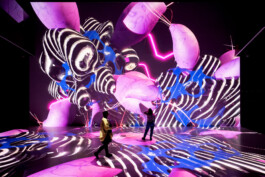
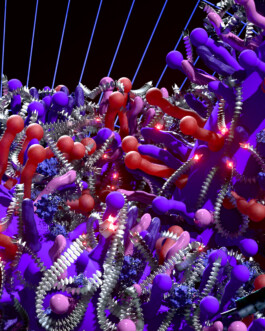
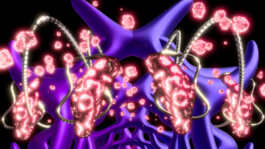
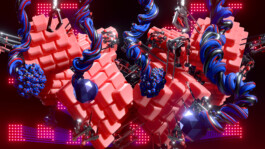
The work navigates the tension between organic matter and technological construction. In surreal, highly stylized spaces, hybrid forms emerge that appear neither distinctly natural nor purely artificial. Plant-like structures merge with digital surfaces, while algorithmic processes evoke biological growth patterns and machine-like systems develop an almost physical presence. This gives rise to a visual world in which familiar categories increasingly blur.
Soft Machines does not view technology as the antithesis of nature, but as part of a shared evolutionary process. The installation poses fundamental questions about identity, perception, and control in a future where humans and machines are increasingly intertwined. Where does the biological end, where does the artificial begin—and what new forms of life might emerge from this union?
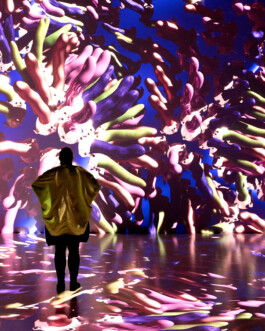
The 6K 3D stereoscopic animation reinforces these questions through an immersive experience that draws the audience spatially and emotionally into this speculative world. Image, sound, and movement merge into a dense, hypnotic atmosphere that offers fewer answers and instead creates an open space for thought. Soft Machines invites us to rethink the relationship between technology and life—not as a clear separation, but as a fluid continuum.
Text by Ars Electronica Solutions & the artist


Installation images by Ars Electronica / Birgit Cakir

SOFT MACHINES
2026, stereoscopic 6k animation with sound, 05:10min
Commissioned for Deep Space at Ars Electronica Center Linz
With Soft Machines, media artist Dagmar Schürrer explores the contemporary notion of the machine through an atmospheric and philosophical lens. While machines were once understood primarily as mechanical tools, their role is undergoing a profound transformation in the age of artificial intelligence, biocomputing, and autonomous systems. Technology is increasingly perceived not merely as a functional instrument, but as a dynamic system that begins to assume qualities traditionally associated with living organisms — including adaptability, autonomy, and continuous transformation.
The work navigates the tension between organic matter and technological construction. In surreal, highly stylized spaces, hybrid forms emerge that appear neither distinctly natural nor purely artificial. Plant-like structures merge with digital surfaces, while algorithmic processes evoke biological growth patterns and machine-like systems develop an almost physical presence. This gives rise to a visual world in which familiar categories increasingly blur.
Soft Machines does not view technology as the antithesis of nature, but as part of a shared evolutionary process. The installation poses fundamental questions about identity, perception, and control in a future where humans and machines are increasingly intertwined. Where does the biological end, where does the artificial begin—and what new forms of life might emerge from this union?
The 6K 3D stereoscopic animation reinforces these questions through an immersive experience that draws the audience spatially and emotionally into this speculative world. Image, sound, and movement merge into a dense, hypnotic atmosphere that offers fewer answers and instead creates an open space for thought. Soft Machines invites us to rethink the relationship between technology and life—not as a clear separation, but as a fluid continuum.
Text by Ars Electronica Solutions & the artist


Installation images by Ars Electronica / Birgit Cakir